Saturday, February 7, 2009

Special Olympics - Fashion Show at Games Fan Festival

Downtown merchants will be hosting a Fashion Show including fashions from fifteen downtown stores. Each store is partnered with a Special Olympic Athlete that will lead the models on stage. The show goes on at 2:20pm on Sunday February 8th and will be emceed by FameFifteen.com.

Parking in public parking garages during the games from February 7-13 will be $5 maximum for the day. First hour remains free followed by $2.50 per hour to a max of $5.

Downtown Boise is ready to welcome the Special Olympics World Winter Games guests. The Downtown Boise Association along with many Downtown businesses has worked with the Special Olympics organizing committee to create a welcoming environment and activities for the many guests visiting our city.

For more information, please visit: www.2009worldgames.org or www.downtownboise.org

You will see many visual signs of the games including over 250 Special Olympic banners that are hanging on the historic street lamps, incredible art graphics on the mural at 8th & Main streets and on the windows along Capital Blvd at BoDo, and posters and unique decorations displayed in merchant’s windows and the impressive graphics on City Hall. In addition check out the banners in the Old Boise historic district that were created by the students at Mountain View High School Art Department under the direction of Art Teacher Laura Fitzer depicting Special Olympic themes.

Blue and white lights representing the colors of the games are on the trees in Grove Plaza and many building owners have left their holiday building lights on for the games, including the tree light on top of the US Bank building which has been dubbed the “giant party hat”.

Many downtown merchants will act as ambassadors for Downtown and will be wearing “Ask Me” ribbons to assist in way-finding and general information about the area. Athletes and officials of the games will receive a downtown map and directory and a downtown coupon book with over 40 offers from downtown merchants.

Michelle Obama's closet: Her fashion choices are inviting, not intimidating

Just how big a fashion icon has Michelle Obama become?

Well, every time she appears in public, there is a "sharp increase in searches for designers that she is wearing when she makes a public appearance," says Google spokeswoman Anne Espiritu. Google's data tracks the spikes on a graph, and hits were clearly highest during the Democratic National Convention in August, election night in November and after Inauguration Day in January.

The statuesque Obama has generated a fashion following enamored with her classic, yet modern, choices and her adeptness at mixing both high-end and affordable pieces. Fond of sleeveless sheaths, sweater sets and whimsical flower jewelry, the new first lady's closet seems more inviting than intimidating to American women inspired by her sartorial sensibilities.

This spring and summer, many of the trends reflect what Obama already wears.

There are bright shades of yellow, plum and blue and bold floral patterns. There are separates that can be worn several ways. And there's an emphasis on accessories that become a focal point of an outfit.

Thursday, January 1, 2009

Using Art Deco

Art deco makes use of strong and sharp angles within each application. The design style of art deco includes groves of thick metal that are then laid within heavy concrete as well as foundations that are full-bodied. If you use it within your home or business, you want to include not online degree course the walls but also the inclusion of art deco furnishings as well. Because its influences include both the Aztecs and Egyptians, you will experience a pyramidal feeling when you visit many buildings that include art deco. A gradual form reduction may give an impression that boasts of vigor and stamina, thus the reason art deco survived when the depression was in existence. It is still capable of having that impact today.

Modern Rebirth

The popularity of the art deco decorating style declined not long after the Great Depression, but recently it has begun to experience a renewed vitality by interested home dwellers, and you should indeed feel free to use online project management courses style of design whenever you want. If you're looking for classic retro styling, you definitely want to think about art deco. You can see numerous examples of this style of design in buildings including one of the tallest buildings in New York finished in 1931. Although many of the skyscrapers that used art deco have been demolished, they are still able to show you an excellent portrayal of the majesty of art deco.

History of Art Deco

Originally, this style was used specifically as a decorative style during the 1920s and 1930s. At that time in history, it was considered not only functional but elegant and ultra modern as well. This style is eclectric in nature and pulls its ideas from many different areas of influence. A few are considered archaic while others are derived from streamlined technology such as aviation. Because of its binding with other techniques that have roots on line course as well as Futurism, art deco includes a wide variety of functionality in addition to articulacy. An interior decorator that uses this style is free to incorporate many different ideas within the internal area of your home's space.

The materials that you use for this design scheme includes stainless steel, inlaid wood, and even sharkskin or zebra skin. When the machine age arrived, harder on line course more metallic materials joined the list of art deco materials. Art deco accomplishes this through repetition and symmetry. Art deco did well during the depression because it was both practical and simple.

History Of Art Deco Design

The profession of interior design has a tradition that goes back many years. The tradition of the profession has included both office buildings and private homes where various principles of design were utilized in order to give the rooms a look that boasted of beauty as well as art. When you embark upon redesigning any interior area, it's pertinent to decide the style you plan to incorporate in your plans before you even begin. Art Deco is among the design concepts that have been in use for several decades.

Home design highlights art of female form

There are men who love women, and then there’s Joe Best, who sees art in the form of women and women in the form of art.

Throughout the extensive art collection in his 6,000-square-foot Peachtree Battle home, recurring images display the glory of the female: the majestic sweep of her hair, the slope of her shape, the glittering gown meant for her.

Best built this home specifically to showcase a mix of paintings and sculpture from every vantage point. But the women command center stage. That’s why he bordered the foyer’s Brazilian cherry floors with an inlay whose lines function like arrows, drawing the eye of one entering the home to the hall’s end. Here, a mesh of red wire lit from above throws against the far wall the shadow of a sculpted female torso.


Saturday, December 20, 2008

Pop Couture

Sometimes the Web is most satisfying when it confirms a cliché from the world offline.

For adventures in digital culture, don't miss The Medium, a blog by Virginia Heffernan.

I’m thinking of the captivating street-style photoblogs, which display snapshots of chic pedestrians in cities around the world. Such blogs exist for Tel Aviv, Stockholm, Moscow, Sydney, Seoul, Berlin, Dublin, London — you name it. Survey them one morning over coffee, and you’ll feel like a boulevardier of the whole world, breezing past one stunning creature after another, free to cruelly assess or dumbly gaze — at supreme leisure and invulnerable to reciprocal scrutiny.

What can be learned from a global anthology of fantastic-­looking people? First off, you might find that looking at people on city streets is almost a perfect allegory of Web-browsing. Tellingly, the major Chinese search engine, Baidu, takes its name from an ancient poem about the search for (what the portal’s FAQ calls) “a retreating beauty amid chaotic glamour.” Anyone encountering the bedlam of the Web seeks a resting place, even — at times — a literal or figurative embrace. The suspense of that exploration is mirrored in the story you find on the street-style blogs: the search for a quiet connection with beauty in a metropolis of strangers.

Designers pull out of Fashion Week

Top designer Betsey Johnson is ending her 5 year run at New York fashion week, instead opting to have a small (about 200 guests-ish) cocktail party where guests can view this season’s designs.

Many other designers are following this new trend and deciding to skip out on the fancy Bryant Park tents. DKNY also decided to stage a presentation rather than a runway show this season, and designers Vera Wang and J. Mendel are also considering going a similar route. Carmen Marc Valvo is also ending their 10 year run in Bryant Park, also opting for a cheaper solution.

While Johnson’s camp did not comment on her decision to not do this year’s fashion week, Valvo did comment and confirm it was because they needed to find a cheaper way to present their designs.

The one bright side to the fashion recession: Betsey Johnson is going to collaborate with a retailer for a limited-time only line that will launch in the fall!!!! Most likely it would be either H&M or Target since they have done this type of thing many times in the past.

And! The even better part to this piece of news is that more designers are likely to follow the trend and make more affordable clothing and collaborate with more retailers!

Betsey Johnson started her line in 1978, making wild, crazy Rock’n’Roll style clothes. She has managed to keep her vision alive for the last 30 years. The only thing left to do is make her clothing more affordable and accessible!

TRIBAL CULTURE

MARRIAGE SYSTEM OF TRIBALS

Among the social institutions, marriage appears to be the most important one. It is practiced almost universally by the tribal people, the only exception being the hos of Kolhan. The extreme cupidity of fathers of kolhan brides and their high sense of family dignity have made them to demand an unusually high price for the hands of their daughter in marriage.

Maiden aged 40 to 50 are a common sight in Kolhan villages. However, recently young man and women began to arrange for their own unions without the knowledge of their parents and went through the operations of mock capture of the bride. The father of the bride in such cases demanded a higher price but not with the hope receiving any payment.

Bridezzz


Season In Bangladesh

Bangladesh is called the land of six seasons (Sadartu). It has a temperate climate because of its physical location. Though the climate of Bangladesh is mainly sub-tropical monsoon, ie warm and humid; Bangla calendar year is traditionally divided into six seasons: Grisma (summer), Barsa (rainy), Sarat (autumn), Hemanta (late autumn), Shhit (winter) and Basanta (spring). Each season comprises two months, but some seasons flow into other seasons, while others are short. Actually, Bangladesh has three distinct seasons: the pre-monsoon hot season from March through May, rainy monsoon season which lasts from June through October, and a cool dry winter season from November through February. However, March may also be considered as the spring season, and the period from mid-October through mid-November may be called the autumn.

Tuesday, December 9, 2008

Desserts

Misti Dhohi: Sweetened yougurt, Halua: a common dessert ranging from egg halua to carrot, sooji or wheat cream, almond, pistachio, nuts and so on. Sandesh: a milk based dessert, one of the best available. Zorda: Sweetened rice with nuts. Firni: rice flour cooked in milk, sugar and flavourant. Rasgolla & Kalojam: two popular milk-based desserts and made with sugar, flour and ghee. Ros Malai: round sweets floating in a thick milk. Pitha: a blanket term for cakes or pastries including specific varieties such as chitoi, dhupi, takti, andsoha, puli, bhapa and pua


Drinks in bd

Cha: The milky sweet tea available almost everywhere, Lassi: the refreshing yogurt drink. Green coconut water is a fine, safe and refreshing drink. International soft drinks, such as Pepsi, Coca Cola, Fanta, 7-up, Mirinda and Sprite are readilly available. Hard drinks are available in big hotels. On Fridays drinking in public areas is not recommended for foreigners.

Food In bd

Western food is available in all major hotels and most of the big restaurants in import cities. But local dishes are normally far better and more exotic. Curries of many kinds around, cooked with proper spices and hot curry powders, including Korma, Rezala, Bhoona and Masala Gosht, Chicken, mutton, beef, fish and prawns, Chicken Afghani, Chicken Baghdadi, Chicken Kashmiri, Chicken Tikka, boti kabab, shutli kabab and a variety of fish curries should be tried. Rice in the form of pulao,

biriani-with rice and mutton or chicken and khichuri are available in any reasonable restaurant. Those who do not care for rice dishes can try mughlai parata, plain parata or naan, which go very well with curries. Seafood and sweet-water fish are available in most of the towns. Fish-lovers should not miss smoked hilsa, fresh bhetki and chingri (lobster/king prawns) malaikari, Prawn dopyaza.

Sunday, December 7, 2008

Dhaka City


Dhaka or Dacca, city, capital of Bangladesh, in Dhaka Division, central Bangladesh. The romanized spelling of the Bengali name was changed from Dacca to Dhaka in 1982. It is located on an arm of the Dhaleswari River in the populous and flood-prone Ganges-Brahmaputra delta and is a major commercial, cultural, and manufacturing center served by the nearby port of Narayanganj. Products include jute, silk, and cotton textiles; carpets; processed food; chemicals; jewelry; and rubber goods. The city's old section, a maze of crowded bazaars and narrow streets, is in marked contrast to Ramna Maidan, a modern well-planned area to the north, where most of the government buildings and educational institutions are located. More than 700 mosques in the city attest to the importance of Islam as the predominant religion. Other landmarks include Lal Bagh Fort and the tomb of Pari Bibi (the wife of a governor of Bengal), both built in the late 17th century, and the large Parliament building (dedicated 1982), designed by Louis I. Kahn. The University of Dhaka (1921), Bangladesh University of Engineering and Technology (1962), and Jahangirnagar University (1970) are located in Dhaka.
An ancient community of uncertain origins, Dhaka rose to importance in the 17th century when it was the Mughal capital of Bengal Province from 1608 to 1639 and again from 1660 to 1704. During that period it became known for the production of fine muslins. The city declined after the capital was moved to Murshidabad in 1704, and it came under British control in 1765. With the partition of British India in 1947, Dhaka became the capital of the Pakistan province of East Bengal, and in 1956 it was made the capital of East Pakistan. The city suffered considerable damage during the 1971 war for independence from Pakistan before becoming the capital of newly independent Bangladesh in late 1971. The city suffered heavy damage during the Bangladesh war of independence (1971). Population (1991) 3,397,190.

Mehedi


Saturday, November 29, 2008

Features of modern coinage


The milled, or reeded, edges still found on many coins (always those that were once made of gold or silver, even if not so now) were originally designed to show that none of the valuable metal had been shaved off the coin. Prior to the use of milled edges, circulating coins commonly suffered from "shaving", by which unscrupulous persons would shave a small amount of precious metal from the edge. Unmilled British sterling silver coins were known to be shaved to almost half of their minted weight. This form of debasement in Tudor England was commented on by Sir Thomas Gresham, whose name was later attached to Gresham's Law. The monarch would have to periodically recall circulating coins, paying only bullion value of the silver, and reminting them. Traditionally, the side of a coin carrying a bust of a monarch or other authority, or a national emblem, is called the obverse, or colloquially, heads. The other side is called the reverse, or colloquially, tails. However, the rule is violated in some cases.[13] Another rule is that the side carrying the year of minting is the obverse, although some Chinese coins, most Canadian coins, the pre-2008 British 20p coin, and all Japanese coins, are exceptions. In cases where a correctly oriented coin is flipped vertically to show the other side correctly oriented, the coin is said to have coin orientation. In cases where a coin is flipped horizontally to show the other side, it is said to have medallic orientation. The latter is found in British coins. Bi-metallic coins are sometimes used for higher values and for commemorative purposes. In the 1990s, France used a tri-metallic coin. Common circulating examples include the €1, €2, British £2 and Canadian $2. The exergue is the space on a coin beneath the main design, often used to show the coin's date, although it is sometimes left blank or containing a mint mark, privy mark, or some other decorative or informative design feature. Many coins do not have an exergue at all, especially those with few or no legends, such as the Victorian bun penny. Not all coins are round. The Australian 50 cent coin, for example, has twelve flat sides. A twist on it is wavy edges, found in the two dollar and the twenty cent coins of Hong Kong and the 10 cent coins of Bahamas. Some other coins, like the British Fifty Pence coin, have an odd number of sides, with the edges rounded off. This way the coin has a constant diameter, recosgnisable by vending machines whichever direction it is inserted. The triangular coin (produced to commemorate the 2007/2008 Tutankhamun exhibition at the The O2 Arena) was commissioned by the Isle of Man, became legal tender on 6 December 2007.[14] and has a value of 25p (a crown). Other triangular coins issued earlier include: Cabinda coin, Bermuda coin, 2 Dollar Cook Islands 1992 triangular coin, Uganda Millennium Coin and Polish Sterling-Silver 10-Zloty Coin.[15] Guitar-shaped coins were once issued in Somalia, Poland once issued a fan-shaped 10 złoty coin, but perhaps the oddest coin ever was the 2002 $10 coin from Nauru, a Europe-shaped coin.[16] Some coins, called bracteates, are so thin they can be struck on only one side. The Royal Canadian Mint is now able to produce holographic-effect gold and silver coinage. For a list of many pure metallic elements and their alloys which have used in actual circulation coins and for trial experiments, see coinage metals.[17] Coins are popularly used as a sort of two-sided die; in order to choose between two options with a random possibility, one choice will be labeled "heads" and the other "tails", and a coin will be flipped or "tossed" to see whether the heads or tails side comes up on top. See Bernoulli trial; a fair coin is defined to have the probability of heads (in the parlance of Bernoulli trials, a "success") of exactly 0.5. A widely publicized example of an asymmetrical coin which will not produce "fair" results in a flip is the Belgian one euro coin[18]. See also coin flipping. Coins are sometimes falsified to make one side weigh more, in order to simulate a fair type of coin which is actually not fair. Such a coin is said to be "weighted".

Genetics and biochemistry of hair color

There are two types of pigments that give hair its color: eumelanin and phaeomelanin. Phaeomelanin colors hair red. Eumelanin, which has two subtypes of black or brown, determines the darkness of the hair color. A low concentration of brown eumelanin in the hair results in blonde hair, whereas a higher concentration of brown eumelanin will color the hair brown. High amounts of black eumelanin results in black hair, while low concentrations of black eumelanin in the hair results in gray hair color. Although most noticeable in red-heads, all humans have varying concentrations of phaeomelanin in their hair.

Phaeomelanin is more chemically stable than black eumelanin, but less chemically stable than brown eumelanin, so it breaks down more slowly when oxidized. This is the reason bleach will cause darker hair to turn reddish-brown during the artificial coloring process. As the phaeomelanin continues to break down, the hair will gradually become orange, later yellow, and then white.

The genetics of hair colors are not yet firmly established. According to one theory, at least two gene pairs control human hair color. One gene, which is a brown/blonde pair, has a dominant brown allele and a recessive blonde allele. A person with a brown allele will have brown hair; a person with no brown alleles will be blonde. This also explains why two brown-haired parents can produce a blonde-haired child. The other gene pair is a not-red/red pair, where the not-red allele (which suppresses production of pheomelanin) is dominant and the allele for red hair is recessive. Since the two gene pairs both govern hair color, a person with two copies of the red-haired allele will have red hair, but it will be either auburn or bright reddish orange depending upon whether the first gene pair gives brown or blonde hair, respectively.

The two-gene model does not account for all possible shades of brown, blonde, or red (for example, platinum blonde versus dark blonde/light brown), nor does it explain why hair color sometimes darkens as a person ages. Several gene pairs control the light versus dark hair color in a cumulative effect. A person's genotype for a multifactorial trait can interact with environment to produce varying phenotypes (see quantitative trait locus).

Grean Tea


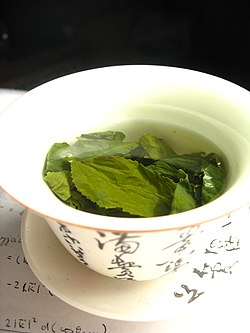
Green tea is a type of tea made solely with the leaves of Camellia sinensis, that has undergone minimal oxidation during processing. Green tea originates from China and has become associated with many cultures in Asia from Japan to the Middle East. Recently, it has become more widespread in the West, where black tea is traditionally consumed. Many varieties of green tea have been created in countries where it is grown. These varieties can differ substantially due to variable growing conditions, processing and harvesting time.

Over the last few decades green tea has been subjected to many scientific and medical studies to determine the extent of its long-purported health benefits, with some evidence suggesting regular green tea drinkers may have lower chances of heart disease and developing certain types of cancer[1]. Green tea has also been claimed useful for weight loss management.